
Blog Archives

10 Reasons Why I am NOT Following You On Twitter

Free twitter badge

Image via Wikipedia

There are no hard rules on Twitter. Just because someone follows you does not mean you have to follow them back.

I tend to be picky about who I follow on Twitter and Facebook. Here are 10 reasons for not following people on Twitter.

1.  Your avatar, (photo), doesn’t exist, is a cartoon character, is half dressed, or is nude. If you haven’t yet bothered to put in an avatar, Twitter shows you as an egg. This tells me you’re either very new, or you don’t care. Using a logo or a cartoon character tells me that you don’t want people to know what you look like. And finally, the only avatars that should be semi-nude, are those people who sell lingerie. I find it very hard to trust people whose avatars are wearing undershirts, bikinis, or other nonprofessional attire. Avatars that are naked women tend to represent spammers, or robots (fake Twitter profiles).

2.  You haven’t tweeted in 30 days or more. Are you still alive? There are a lot of people on Twitter who seem to abandon their Twitter accounts after a month. It is hard to tell this unless you go back and look at their last tweet.

3.  All your tweets are quotes. While quotations are useful in certain situations, if all you’re doing is tweeting somebody else’s words, then you obviously aren’t very interested in talking to others on Twitter.

4.  You have protected your Twitter updates. This shows that you completely miss the point of social media. Social media lets us engage with people and show two sides of the conversation (yours and others). Some people seem to think that protecting ones’ updates equals privacy. This is a fallacy because we can still see your profile.

5.  You use foul language in your profile or tweets, (continuously). Unless you are a third grader, civilized conversations don’t require profanity.

6.  All your tweets are advertisements, you selling something, or spam. This is one of the biggest mistakes made on Twitter. Think of Twitter or any social network as a cocktail party. You wouldn’t go up to the nice-looking girl by the punch bowl and say “You really need to buy my new book about weight loss.” That would probably get you a slap in the face. Instead, what you would actually do is engage the person in conversation, win their trust, and then lead the conversation to something about your new book. Twitter is the same. This includes automatic direct messages (DM). Talk, engage in conversations, and then lead into products.

7.  All of your tweets are forwards (RTs) of other peoples’ tweets. This is the same problem as using all quotations. Where are your thoughts? Or is it that you don’t have anything important to say? This sort of behavior leads people to think that there is no real person behind the Twitter handle.

8.  You tweet the same tweet over and over and over again. This is against Twitter’s guidelines, and again leads to my assumption that you are a bot (robot).

9.  Your profile has nothing on it. You need to give me something to go on, your interests, where you’re located, or what you do. Be careful of the location section of the profile. Writing, “Planet Earth”, or “Everywhere”, is useless to most of us.

10.  And the big one: if you are following more than 10,000 people, (and you’re not @GuyKawasaki, or a celebrity), my assumption is that you’re using one of the automatic Twitter follower programs. I doubt very much that you are following the conversations of all 20,000 people, or even engaging any of them.



The Social Pushmepullyou

Pushmepullyou again
Image by Chrstopher via Flickr

Do you remember the Pushmi-pullyu from Hugh Loftings’  original Dr. Doolittle series? This was a two-headed creature, with a head at each end. Facebook and Twitter are very similar to this animal.

Twitter is the “push me”  part of it.  Twitter, Plurk, and other micro-blogging applications push users to click on links. This is due in part to the 140 character limit, and in part to the way many people use micro-blogs.

Facebook, on the other hand, is a pull technology. Once you’re pulled into the website, it never wants to let you go. This is due to the nature of the stickiness of the site, the games that are found there, and the many other nooks and crannies that you can explore there. There are several other social networks that do this as well, but Facebook is the best example of this.

The trick is to use these two types of technology to your best advantage. An example of this would be to use the micro-blogs to push people to your Facebook page (the former “fan page”), and then make that Facebook page as sticky as possible. Finding the right balance can be hard. What you don’t want to do, is to create only a Facebook page, and no website for the user to ultimately end up on. Again, going back to a previous post, social media is transient in nature. Whatever pages you create on social networks may not be there in the future, or may become inaccessible. So, my advice to you is to cover all your bases.

Enhanced by Zemanta


Social Media or SEO?

Social-Media-Campaign
Image by Gary Hayes via Flickr

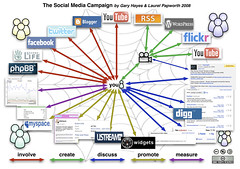
I have been noticing a worrisome trend lately. Many businesses have decided to  go with social media (i.e. Facebook, Twitter, etc.) before making sure that 1) their website is fully optimized for users (or search engines), or 2) that their website is fully functional.

While I agree that using social media is a very useful technique for pushing people to a website, there needs to be a fully usable website on the other end. There is nothing so frustrating as following a link in Twitter, only to discover that the information you’re interested in can’t be found on that particular page.

Another problem is that social media is transient in its very nature. What is popular today may not be popular tomorrow. You must make sure that your website will be found by people who are not only active in social media, but who are looking for your site in the search engines using particular keywords.

Before you jump on the social media bandwagon, you must make sure that your website is not only user-friendly, but search engine friendly as well. Optimizing your website is crucial for the long term. I know, I know, doing SEO on your website is not as exciting as posting to your friends on Twitter, but think of it as a necessity, as a way of standing out in the crowd of websites.

Enhanced by Zemanta


Social Media and Gustav

It is really fascinating to watch the deployment and preparations for Gustav from my computer. Twitter allows me to follow CNN reporters, disaster doctors “tweeting”, people on the ground, and the various emergency networks coming together online. Several new networks such as one on Ning.com and others are being set up and people are being asked to pass the word to the “non-geeks” as well.


What is SMO?

A lot of people know about search engine optimization, or SEO, but SMO is a relatively new term. It stands for social media optimization and goes along with the phenom of “Web 2.0.” SMO is another technique to help a website or brand show up in the search engines.

Social media optimization basically includes placing a website/person/product/service on the various social media networks (Facebook, Ning, MySpace, LinkedIn, etc.), and social bookmarking sites (del.icio.us, Mixx, BackFlip, Digg) so that the search engines see more inbound links.

The trick is to know which ones of the hundreds out there of social media sites are the best. One place to find this information is at my Squidoo page, Online Networking.

Another interesting ebook is The Definitive Guide to Finding the Best Social Marketing Sites . Bill Ortell has taken the time to go through the many sites and subject them to specific criteria. He examines social networks, bookmarking sites, and video sites. I heartily recommend this book as an excellent place to start.