
I have a Lonely Website, Now What?

Magnifying glass with website
Question: Everyone told me I needed a website for my business. So, I had one built, but no one visits it. What am I doing wrong?
Answer: In the early days of the World Wide Web, just putting up a website was enough, as there were only a few thousand web pages out there. Nowadays, with over 30 billion websites online, you need to do more to attract traffic. SEO is one technique.
Jon Rognerud, in his book, The Ultimate Guide to Search Engine Optimization (2011), says, “Search engine optimization is the process of making your website more accessible or visible to search engines via tactics that involve on-page (text, code, links) and off-page (external link development) activities. The goal of optimization is to have the spiders not only find your site and pages but also specifically rank the page relevance..” (page 27). The spiders that Jon mentions are from the search engines such as Google, Bing, etc.
In other words, search engine optimization (SEO) can be described as building a roadmap from the search engines to your website so that people can find your product or service based on the keywords they type into the search engines. A search engine is basically an information retrieval tool. These tools send out spiders on the Web to index websites and store them in their databases.
Think about it. When people use a search engine, they are looking for keywords, not the name of your business. As an example, someone would type in “car detailing Boston”, not “Frank’s carwash”. SEO is used to alert the spiders that a specific website contains the specific keywords, as well as a geographic location.
There are a number of steps in the SEO process. The three most important ones are: keyword research, page optimization, and metadata. The first step is keyword research. Often the owner of the business does not realize what keywords the potential customer will be using. The technical terms the owner uses are not the same terms the public uses. Research is used to discover what words are being used to search for similar businesses, and where those keywords should appear on the website as well as in the HTML code. Often, the competition’s websites will be checked for what keywords they use as well.
Once the keywords are established, the website itself is checked to make sure it is as user-friendly and search engine friendly as possible. This includes making sure the navigation works, checking that all the inner links work, proofreading, and a number of other aspects of the website. If changes need to be made, the owner is alerted and recommendations are made for changes.
Finally the metadata needs to be built. This term refers to what are known as the meta-tags in the code of the website. Each page needs to have its own title tag, and a description. The search engines use the description tag as the snippet of information that appears in their results.
Once all changes are made and the metadata added, the website can then be submitted to the most important search engines and directories. Google indexes websites and a specific website can take up to three months to appear, so the website will not appear in Google the next day. Not everyone submits websites, many just wait for the engines to find it on their own.
Many people want a guarantee that their website will show up in the top 10 results of the engines. Due to the many, many factors that the search engines use to rank websites, the top 10 cannot be guaranteed. If anyone says they can guarantee this, run the other way as fast as possible.
Not Every Business Needs A Facebook Page
Facebook has 699 million daily active users (as of June 2013), but according to Facebook’s own estimate, 80% of them are outside of the United States and Canada. And, although a lot of businesses are on the social network, not all businesses do well there.
What many businesses don’t understand is that Facebook is really a “social” network, where people come to talk and share information. Service businesses rarely make much of an impact and to use any social media successfully it requires dedicated amounts of time and diligence that a business owner either has to put in or should hire someone to do.
The most successful businesses on Facebook fall into these seven categories:
- Retail (well-known stores, odd or unusual products)
- Bars and Nightclubs
- Restaurants
- Big, nationally known brands (Coca-Cola, Nike)
- Sports teams (and a recent article disputed this)
- Actors/Celebrities
- Musicians/Bands
In May of 2013 , the article Maybe You Don’t Need Social Media to be Successful states:
One USA Today report reveals that social media may not be the answer for everyone…About 61% of small businesses don’t see any return on investment on their social-media activities.
In the post, When Small Businesses Shouldn’t Do Social Media, social media and marketing specialist Stephanie Schwab confesses:
As someone who is deeply entrenched in, and very much in love with, social media, it’s very hard to say ‘Don’t do social media.’ But honestly – more and more, I find myself telling some of these entrepreneurs and business owners that social media may not be the most important thing for them to do….
Others point out that there are some huge, successful businesses that don’t use social media at all, Apple being the most unexpected example.
Also, ignoring your target market is one of the biggest mistakes local businesses make. Before jumping into the social media venue, first find where your prospective customers are who are looking for the services you offer.
The Yellow Pages used to be the place to advertise in, but is rapidly being replaced by online directories. There are online Yellow Pages, but again, they are often confusing, and sometimes have incorrect or outdated information.
Ask your current customers to post reviews for you on websites like Yelp, MojoPages.com, and TripAdvisor.com (they now show businesses as well as restaurants). Make sure you list your website in Yahoo Local, Bing Local, and Google Plus (a.k.a. Google Places).
If your business handles commercial services, such as industrial plumbing or cleaning, be sure to get a company page on LinkedIn. LinkedIn is one of the biggest business-to-business networks online today.
Many Chamber of Commerce and other business organizations and local networking groups have websites

Local businesses (Photo credit: Wikipedia)
and an online business directory for their members. This is an excellent resource for prospective clients, because they will continue to refer you to their friends and colleagues.
And don’t forget about offline marketing. If you can find a charity or other non-profit corporation that is running an event in your area, see if you can be a sponsor. Many of these organizations will list their sponsors in their printed material, signs and banners at the event itself. Or, you can see about sponsoring a local conference or fund-raising event.

Hyphenated Domains: A Good Idea or Not?

Domain Names (Photo credit: ivanpw)
Most SEO people agree that having a single dash or hyphen (-) in a domain name is not a bad thing. Technically, the search engines still see the keywords in the URL and ignore the hyphens.
In the past, spammers have over-used hyphens to try and direct unsuspecting users to their own websites. Having two to three hyphens in a domain name is what has given hyphenated domains such a bad reputation.
Several articles point to the fact that hyphenated domains still appear in Google’s results (and many of these websites are high quality), and are therefore not being penalized for having hyphens.
Using hyphens is not good for branding a specific product or service, but a keyword rich domain name with a dash will still rank highly.
Sources:
Jon Rognerud (Author of The Ultimate Guide to Search Engine Optimization), personal communication.
http://www.werockyourweb.com/domain-name-with-or-without-hyphens (Feb 2012)
Hyphenated Domain Names: Use Or Avoid?
Posted on January 5, 2012 by Sergie Matthis
http://kevin-pike.com/hyphenated-domain-names-use-or-avoid/

10 Reasons Why I am NOT Following You On Twitter

Image via Wikipedia
There are no hard rules on Twitter. Just because someone follows you does not mean you have to follow them back.
I tend to be picky about who I follow on Twitter and Facebook. Here are 10 reasons for not following people on Twitter.
1. Your avatar, (photo), doesn’t exist, is a cartoon character, is half dressed, or is nude. If you haven’t yet bothered to put in an avatar, Twitter shows you as an egg. This tells me you’re either very new, or you don’t care. Using a logo or a cartoon character tells me that you don’t want people to know what you look like. And finally, the only avatars that should be semi-nude, are those people who sell lingerie. I find it very hard to trust people whose avatars are wearing undershirts, bikinis, or other nonprofessional attire. Avatars that are naked women tend to represent spammers, or robots (fake Twitter profiles).
2. You haven’t tweeted in 30 days or more. Are you still alive? There are a lot of people on Twitter who seem to abandon their Twitter accounts after a month. It is hard to tell this unless you go back and look at their last tweet.
3. All your tweets are quotes. While quotations are useful in certain situations, if all you’re doing is tweeting somebody else’s words, then you obviously aren’t very interested in talking to others on Twitter.
4. You have protected your Twitter updates. This shows that you completely miss the point of social media. Social media lets us engage with people and show two sides of the conversation (yours and others). Some people seem to think that protecting ones’ updates equals privacy. This is a fallacy because we can still see your profile.
5. You use foul language in your profile or tweets, (continuously). Unless you are a third grader, civilized conversations don’t require profanity.
6. All your tweets are advertisements, you selling something, or spam. This is one of the biggest mistakes made on Twitter. Think of Twitter or any social network as a cocktail party. You wouldn’t go up to the nice-looking girl by the punch bowl and say “You really need to buy my new book about weight loss.” That would probably get you a slap in the face. Instead, what you would actually do is engage the person in conversation, win their trust, and then lead the conversation to something about your new book. Twitter is the same. This includes automatic direct messages (DM). Talk, engage in conversations, and then lead into products.
7. All of your tweets are forwards (RTs) of other peoples’ tweets. This is the same problem as using all quotations. Where are your thoughts? Or is it that you don’t have anything important to say? This sort of behavior leads people to think that there is no real person behind the Twitter handle.
8. You tweet the same tweet over and over and over again. This is against Twitter’s guidelines, and again leads to my assumption that you are a bot (robot).
9. Your profile has nothing on it. You need to give me something to go on, your interests, where you’re located, or what you do. Be careful of the location section of the profile. Writing, “Planet Earth”, or “Everywhere”, is useless to most of us.
10. And the big one: if you are following more than 10,000 people, (and you’re not @GuyKawasaki, or a celebrity), my assumption is that you’re using one of the automatic Twitter follower programs. I doubt very much that you are following the conversations of all 20,000 people, or even engaging any of them.

The Social Pushmepullyou

- Image by Chrstopher via Flickr
Do you remember the Pushmi-pullyu from Hugh Loftings’ original Dr. Doolittle series? This was a two-headed creature, with a head at each end. Facebook and Twitter are very similar to this animal.
Twitter is the “push me” part of it. Twitter, Plurk, and other micro-blogging applications push users to click on links. This is due in part to the 140 character limit, and in part to the way many people use micro-blogs.
Facebook, on the other hand, is a pull technology. Once you’re pulled into the website, it never wants to let you go. This is due to the nature of the stickiness of the site, the games that are found there, and the many other nooks and crannies that you can explore there. There are several other social networks that do this as well, but Facebook is the best example of this.
The trick is to use these two types of technology to your best advantage. An example of this would be to use the micro-blogs to push people to your Facebook page (the former “fan page”), and then make that Facebook page as sticky as possible. Finding the right balance can be hard. What you don’t want to do, is to create only a Facebook page, and no website for the user to ultimately end up on. Again, going back to a previous post, social media is transient in nature. Whatever pages you create on social networks may not be there in the future, or may become inaccessible. So, my advice to you is to cover all your bases.

Social Media or SEO?
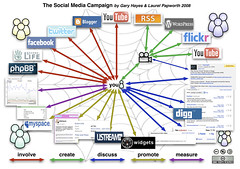
- Image by Gary Hayes via Flickr
I have been noticing a worrisome trend lately. Many businesses have decided to go with social media (i.e. Facebook, Twitter, etc.) before making sure that 1) their website is fully optimized for users (or search engines), or 2) that their website is fully functional.
While I agree that using social media is a very useful technique for pushing people to a website, there needs to be a fully usable website on the other end. There is nothing so frustrating as following a link in Twitter, only to discover that the information you’re interested in can’t be found on that particular page.
Another problem is that social media is transient in its very nature. What is popular today may not be popular tomorrow. You must make sure that your website will be found by people who are not only active in social media, but who are looking for your site in the search engines using particular keywords.
Before you jump on the social media bandwagon, you must make sure that your website is not only user-friendly, but search engine friendly as well. Optimizing your website is crucial for the long term. I know, I know, doing SEO on your website is not as exciting as posting to your friends on Twitter, but think of it as a necessity, as a way of standing out in the crowd of websites.

Adding a Glossary to a Website

- Image by LexnGer via Flickr
A good way of getting more keywords on a website is to put together a glossary of terms. This has two main advantages.
First, by putting in a list of definitions, you make the website more of a content site, and one that will be seen for information. It is a great service to your customers and prospects as well.
A great example of this is Grand Entrances . I helped set up this glossary of terms about doors (and learned a lot while doing it). Now, when customers come to the website, they can better understand what the descriptions are referring to.
Secondly, a glossary allows you to pinpoint the keywords that you want the search engines and users to see. Often, a website has too many keywords to be clumped together on the home page. With a list of terms, you can both inform and educate.
![Reblog this post [with Zemanta]](http://img.zemanta.com/reblog_b.png?x-id=87b6ccfe-556b-48ab-ad12-f4d9404ad2b8)
Inbound Links

- Image via Wikipedia

In order to rank well on the search engines, you need to have other websites pointing to your website. These are known as inbound links. There are a number of ways of getting inbound links to your site, and several older techniques that are no longer very useful.
One of these older techniques is known as a link exchange. Link exchanges are when a number of different websites agree to exchange links. Nowadays, this method only works if you can find related websites to your subject that do not compete with you.
In other words, if you are selling furniture online, you would welcome links from websites selling furniture polish or soap, since they are not competing with you. However, if your website is about pets, you would not want a website selling animal traps to link to you.
The best way to get inbound links is to use search engines to find popular websites that are in your general field. You can then ask for a return link. I suggest emailing the webmaster for the link, using your own words, not some canned program.
Keep in mind that you do not want a lot of links all at once. That will look suspicious to the search engines. Gradual link building is best.
![Reblog this post [with Zemanta]](http://img.zemanta.com/reblog_e.png?x-id=694ee164-03f6-4cbd-9a67-3e4aeb176144)
Google is a Big Bully

Image via Wikipedia
There is currently a discussion on MyVirtualPowerForum about Google being evil. This was my first response to the discussion.
While I do not consider Google “evil” (I reserve that label for the really bad things in life), I do think that they are the big bully on the block.
For all the reasons given here and more, Google has decided that it is the search engine “God”, and whatever it decides goes.
Well, this only works if your SEO person only optimizes your website for Google. I have never followed this method because it puts you at the mercy of them. There are many techniques (especially now with social marketing) around the monolith of Google.
What I find funny is when Google spokespeople openly lie (IMHO), and all these SEO discussion forums obediently fall in line with the supposed policy. An example was the pronouncement from on high (Matt Cutts) that Google does not consider “.gov” or “.edu” sites to be authoritative. What pure nonsense!
Another stupid comment from them was that they no longer use inbound links from directories. Yeah, right.
Google’s biggest, and ongoing lie (IMHO) is their use of PageRank. The supposed PR that you see people claiming that their site ranks for is useless. First of all, the term PageRank, is named for Larry Page, not after a web page. Secondly, the PR you can see on the Google Toolbar is not what Google is using. What Google is using is a trade secret.
And finally, PR is not important in the bigger picture. What is important is where your site ranks in the organic results on any search engine, and where it appears for the keywords that you want it to appear for.
![Reblog this post [with Zemanta]](http://img.zemanta.com/reblog_e.png?x-id=69849fad-85cf-44c9-9e55-272b22221706)